

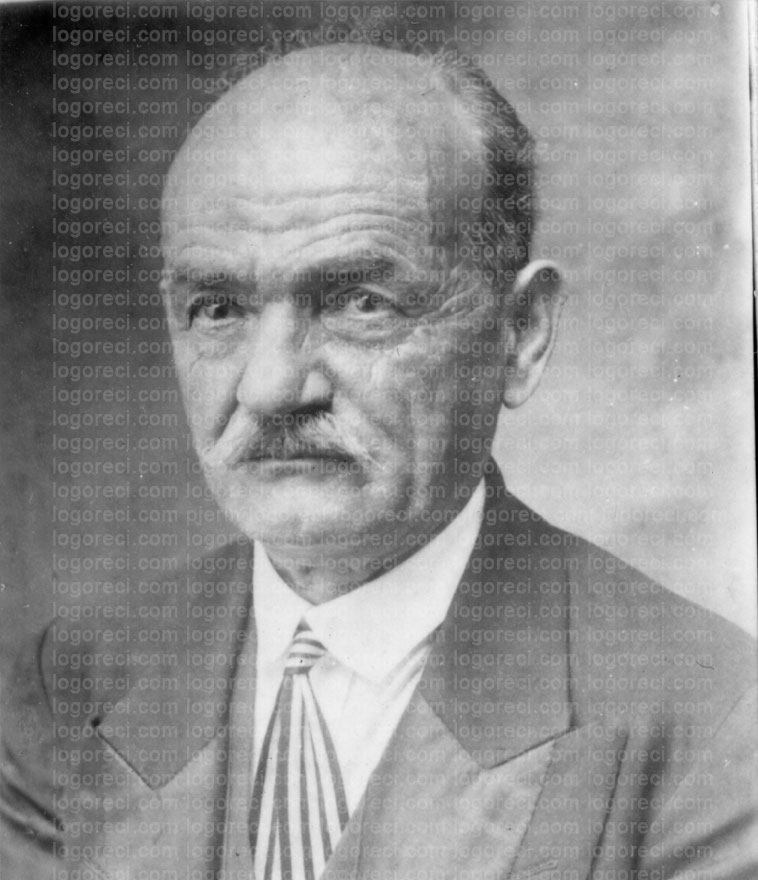
Born in Shkodër on February 10, 1867, Mati Logoreci was the son of Frano Logoreci and Marije Thaçi. He received his early education in his hometown. At the age of 10, in 1877, his parents sent him to attend the technical commercial school that had recently opened in the city. Logoreci learned to read and write in Albanian, as well as Italian, French, and later German. He continued his education for four years at the Saverian College in Shkodër, gaining extensive knowledge in economics and trade.
He worked as an apprentice at the Parruca trading company, which sent him as an accountant to Monfalcone, near Trieste. During this time, he came into contact with the writings and works of Jeronim de Rada, Dora d’Istria, Serembe, Stratigoi, and Santori, as well as periodicals published in Sofia, Bucharest, and Istanbul, and the publications of the Frashëri brothers, Pashko Vasa, and Zef Jubani.
After working in Italy, he went to France for a short period of study. Upon returning to Albania, Bishop Andrea Logoreci, Mati’s uncle, observing the shortage of language teachers in the area, sent his two nephews, Mati to Prizren and Pashko to Gjakova. On May 1, 1889, Mati Logoreci opened the first Albanian-language school in Prizren, an institution which, after restoration, today bears the name "Shkolla Mati Logoreci”.
In Prizren, he started a family, marrying Paulina (born Jan 3, 1878), the daughter of Toma and Ndresha, on September 24, 1894. They had four children: Kolë Logoreci, Gjon, Marta, and Shaqe. He taught there for some time but eventually resigned following a conflict with the Austro-Hungarian consulate, which oversaw the education of Catholic Albanians under the Kultusprotektorat. In 1899, Logoreci established another private Albanian school, which, according to historical documents, enjoyed widespread support. Both schools merged in 1900. He served as a teacher in Prizren until 1903, when he was transferred to the Franciscan school in Shkodër.
On November 14, 1907, he began publishing the bi-weekly newspaper "Dashamiri" in Trieste, using the "Agimi" alphabet. The newspaper was short-lived, with only fourteen issues published until its closure on August 6, 1908. In November 1908, Logoreci represented the "Agimi" society of Shkodër at the Congress of Manastir, alongside the poet Ndre Mjeda. Mjeda, who was not only his maternal first cousin but also a close friend and collaborator, had a profound influence on his linguistic studies. They participated alongside At Fishta, Hilë Mosi, and Luigj Gurakuqi. In 1908, together with Lazër Mjeda (the brother of poet Ndre Mjeda), he organized an Albanian night school in Shkodër. Under the auspices of this club, he published a 201-page textbook on ancient history titled "Ndolliina historijet t'motshme" (Shkodër, 1911), which covered the ancient history of Illyria, Macedonia, and Epirus, including overviews of ancient Egypt and Greece.
He collaborated with prominent language and history scholars across Albanian territories and abroad, exchanging ideas on the development of the Albanian language. Beyond his family ties with Ndre Mjeda, Mati Logoreci enjoyed the friendship and respect of national figures such as Gjergj Fishta, Luigj Gurakuqi, Aleksandër Xhuvani, Nikolla Ivanaj, and the Austrian Albanologist Norbert Jokl. This direct contact with eminent political, scientific, and social personalities deeply influenced the formation of his worldview.
After Independence, Logoreci served as a teacher in Tirana, and from 1916 to 1918 as an education official in Shkodër. In 1916, he was a member of the "Albanian Literary Commission" (Komisia Letrare Shqype) established by Austro-Hungarian authorities. In 1920, he participated in the Congress of Lushnja as a delegate for Shkodër.
In 1920, Matija renamed the administrative institution of Shkodër as the Bashki (“Bashki” means “city hall” in Albanian) (formerly called Belediye in Turkish until 1913). This naming convention was subsequently adopted by all similar institutions across Albania and remains in use today.
On December 10, 1920, the National Library of Albania was founded, placed under the stewardship of Prof. Mati Logoreci by the Ministry of Education.
From 1922 to 1923, he served as the Secretary General of the Ministry of Education and remained dedicated to the field of education until his retirement in 1930.
In the final years of his life, Mati Logoreci returned to journalism with the newspaper "Drita," which launched on November 28, 1936, and continued until at least 1939. "Drita" had a circulation of 4,000 copies, making it the largest Albanian newspaper in the years preceding World War II. Mati Logoreci personally edited the first ninety-three issues until March 23, 1937.
In addition to "Ndolliina historijet t'motshme," Logoreci authored several other school textbooks and historical works, the most notable being the 301-page book "Historija e përgjithshëme" (General History), Shkodër 1924. He was recognized as a linguistic purist of his northern dialect. Mati Logoreci passed away on February 7, 1941, in Tirana at the age of seventy-four, a distinguished figure in Albanian education.
Numerous articles have been written about his life and work, including the biography: *Mati Logoreci* by Prof. Dr. Musa Kraja (1987, revised in 2001).
Knight of the Order of the Crown of Italy (Cavaliere dell'Ordine della Corona d'Italia) - December 2, 1929
Commander of the Order of Skanderbeg (Komandar i Urdhrit të Skënderbeut) - February 6, 1930
"Teacher of the People" (Mësues i Popullit) - 1987
Mati Logoreci Street, Tirana
"Mati Logoreci" School, Shkodër
"Mati Logoreci" School, Prizren
Vatican News (Albanian)
Wikipedia (Albanian)
Grokipedia (English)
Wikipedia (English)

Cavaliere D'Italia (1929)

Order of Skanderbeg (1930)